Preface to Paradise Lost
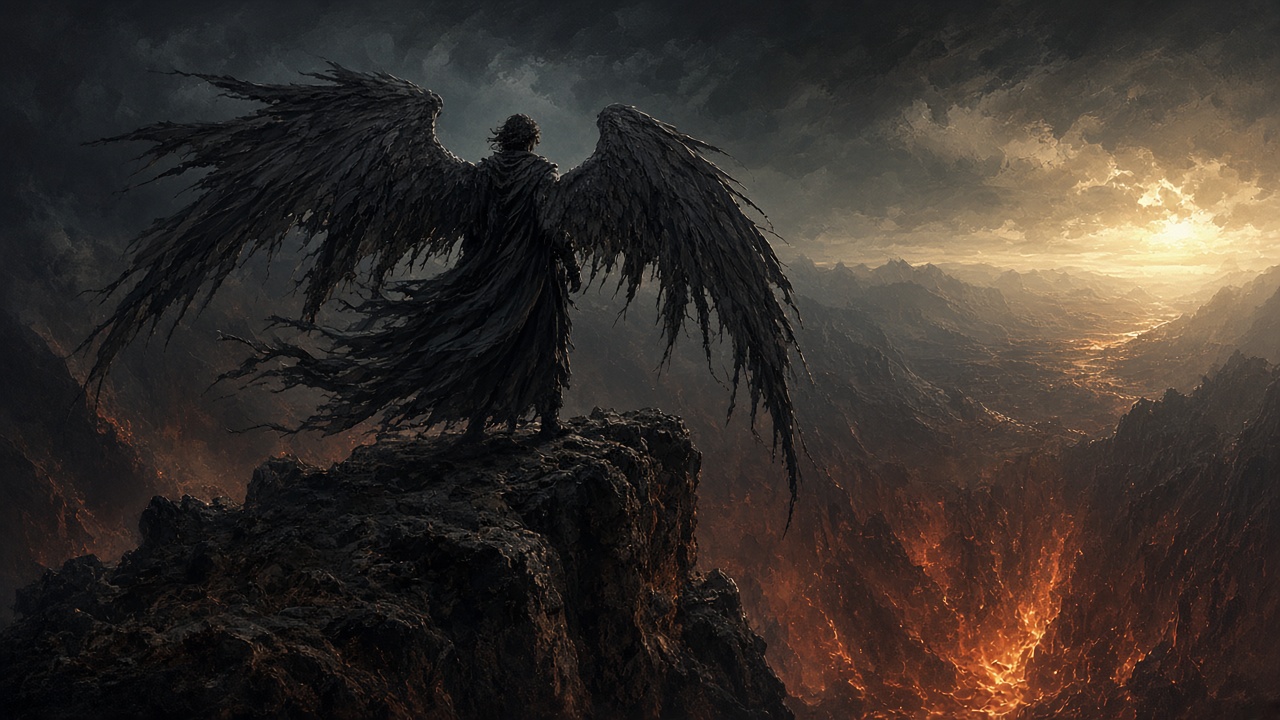
Before judging a work, one must know what it intends to be. Lewis defends Milton’s epic against its critics and dismantles the romantic myth of Satan as a heroic figure.
The first part explains what a “secondary,” scholarly epic is, as opposed to Homer’s, and why its solemn style is intentional. The second part examines the theology of the poem. Lewis challenges the romantic interpretation, from Blake to Shelley, which casts Satan as the true hero of the work: for him, Satan is a brilliant character to write about but ridiculous in his self-deception, ending up as a serpent after having been an archangel.
- Original title — A Preface to Paradise Lost
- First publication — 1942
- Genre — Literary criticism
- First English edition — Oxford University Press, 1942; dedicated to Charles Williams
- Availability in bookstores — Not translated into French to our knowledge.
- Reading level — Demanding
- For whom — For students and readers of Milton.
- Year — 1942
themes
- Judging a work based on what it intends to be.
- Satan’s pride and his degradation.
- The hierarchy and order of the world.
Short quotes with source
- Before judging a work, whatever it may be, one must know what it is. — A Preface to Paradise Lost, ch. 1 — translation from the website
Family
Literary criticism
Other names
- A Preface to Paradise Lost
- Literary criticism
Before judging a work, one must know what it intends to be. Lewis defends Milton’s epic against its critics and dismantles the romantic myth of Satan as a heroic figure.
Quick facts
How to approach it
Level: Demanding. For students and readers of Milton.
Summary in a few lines
The first part explains what a “secondary,” scholarly epic is, as opposed to Homer’s, and why its solemn style is intentional. The second part examines the theology of the poem. Lewis challenges the romantic interpretation, from Blake to Shelley, which casts Satan as the true hero of the work: for him, Satan is a brilliant character to write about but ridiculous in his self-deception, ending up as a serpent after having been an archangel.
In Lewis’s workshop
Derived from the Ballard Matthews lectures given in 1941 at the University College of North Wales, in Bangor. Lewis expands on the insights of Charles Williams, to whom the book is dedicated. It was written at the same time as Perelandra, which replays the temptation of Eve.
What announces Narnia
The White Witch, beautiful, cold, and majestic, is viewed with the same perspective as Milton’s Satan: impressive, but empty.
What a modern reader retains
Our culture loves fascinating villains. Lewis reminds us that a character can be magnificent to write about yet empty in his self-deception. This lesson in reading applies to Milton as much as to the White Witch, and to many “charismatic villains” in films today.
Its lasting influence
A classic work of Milton studies, long part of the curriculum in English-speaking universities, notably discussed by William Empson.
Key ideas
- Judging a work based on what it intends to be.
- Satan’s pride and his degradation.
- The hierarchy and order of the world.
Quotes
“Before judging a work, whatever it may be, one must know what it is.”
— A Preface to Paradise Lost, ch. 1 — translation from the website
See also
- Perelandra
- A Lion in the English Wilderness: Charles Williams, or the Invisible at the Inklings’ Table
- The Last of the Dinosaurs: A Medievalist in Oxford and Cambridge, and What Narnia Owes to His Library
- White Witch
Sources
- https://en.wikipedia.org/wiki/A_Preface_to_Paradise_Lost
Échanges entre lecteurs
Une question, un souvenir de lecture, une idée ? Partagez-les avec les autres lecteurs, dans le respect de la charte des commentaires.
Les commentaires ne sont pas disponibles pour le moment.
Les commentaires sont fermés sur cette page.
Aucun commentaire pour le moment. Soyez la première personne à partager votre avis !
Merci ! Votre commentaire sera visible après relecture.