The creatures of Narnia
Fauns, centaurs, dwarfs, Marsh-wiggles, Talking Beasts… the complete bestiary of Narnia, arranged by family.
The bestiary
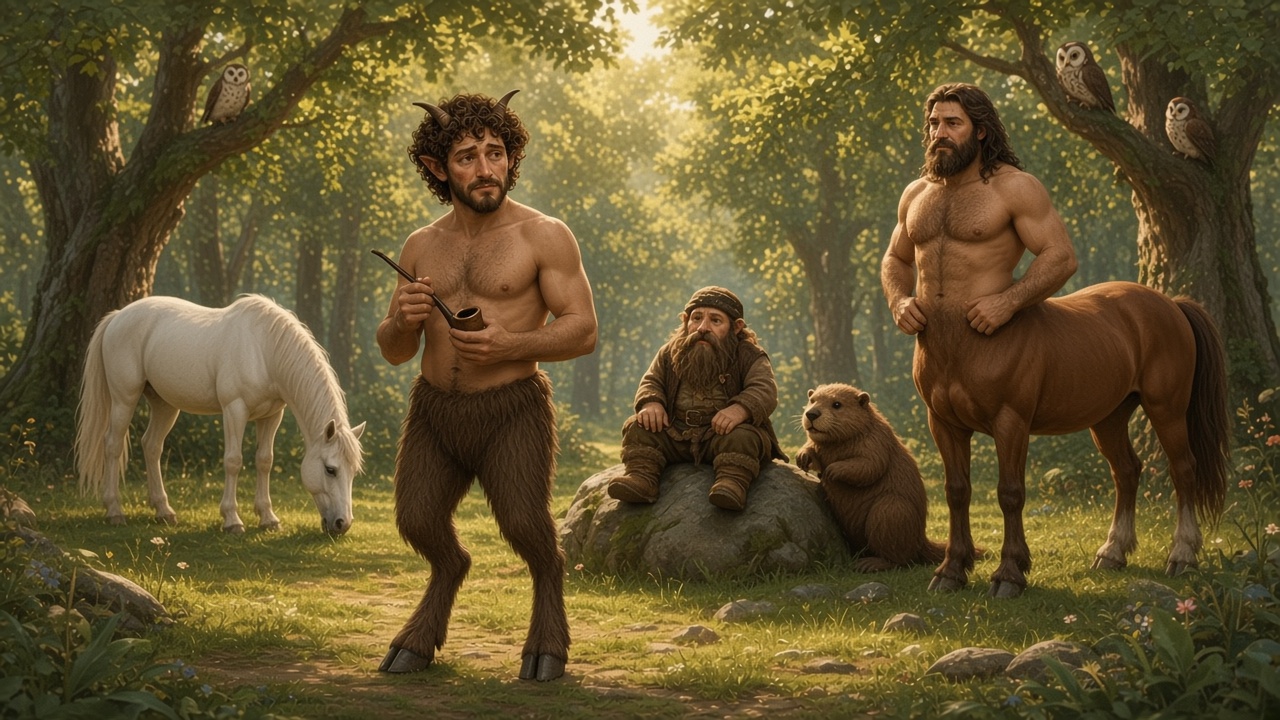
- 44 peoples and creatures.
- Graeco-Roman mythology, Norse mythology, and Lewis's inventions.
- A detailed entry for each one.
Lewis drew on Graeco-Roman mythology, Norse legends, British tales and the medieval bestiary. He added inventions of his own, such as the Marsh-wiggles or the Dufflepuds. Here are all the peoples of the world of Narnia, each with its own entry.
Mythological creatures
- Fauns: They are two-legged creatures with a human torso and face, small horns and two goat's legs, the musicians and dancers of Narnia.
- Satyrs: They are the rougher, wilder cousins of the fauns, and they fight on both sides.
- Centaurs: They are beings half man and half horse, grave, wise astrologers, and formidable warriors.
- Dryads, Hamadryads: They are the spirits of the trees, bound to the life of their own tree, and they dance and speak when Narnia is awake.
- Naiads: They are the nymphs of the waters of Narnia, bound to the rivers and the springs.
- River gods: They are the spirits of the rivers, such as the god of the Great River, chained by the bridge at Beruna.
- Maenads: They are the wild young women, and the companions of Bacchus, who dance in the train of Bacchus and Silenus at the waking of Narnia.
- Minotaurs: They are creatures with a man's body and a bull's head, and they fight chiefly in the White Witch's army.
- Unicorns: The unicorns of Narnia are noble and formidable, and Jewel is the friend of King Tirian.
- Gryphons: They are creatures half eagle and half lion, in Aslan's army.
- Phoenix: It is the firebird glimpsed in the garden of Aslan's Country, in The Last Battle.
- Winged horses: They are the winged horses of Narnia, among them Fledge, the first, a former cab-horse transformed at the Creation.
- Dragons: The dragons of the world of Narnia run from the old dragon of Dragon Island to Eustace after he is transformed.
- Sea serpent: It is the sea monster that attacks the Dawn Treader and tries to crush the ship in its coils.
- Stars: The stars of the world of Narnia are living people: planets, constellations, and stars at their rest, such as Ramandu and Coriakin.
Talking Beasts
- Talking Beasts: They are the animals Aslan chose at the Creation, so as to give them speech, reason and freedom, and they form the heart of the Narnian people.
- Beavers: The talking beavers, builders and hospitable, are represented by Mr and Mrs Beaver in The Lion, the Witch and the Wardrobe.
- Badgers: The badgers of Narnia are keepers of memory and of loyalty, as Trufflehunter is.
- Talking Mice: They are the mice who were given speech for having gnawed through Aslan's cords on the Stone Table, and Reepicheep is their chief.
- Talking Horses: The horses of Narnia who are gifted with speech are free and proud, and Bree, Hwin and Fledge are the most famous of them.
- Talking Cats: The Talking Cats of Narnia include Ginger, the cynical smooth talker of The Last Battle.
- Talking Birds: The Talking Birds of Narnia, from the eagle Farsight to the raven Sallowpad and the pelican, are messengers and watchers.
- Owls: The owls of Narnia hold a secret parliament in a ruined tower, and they help Jill and Eustace.
- Squirrels: The talkative, lively squirrels of Narnia include Pattertwig, a messenger in Prince Caspian.
- Bears: The bears of Narnia include the three Bulgy Bears, who hold the traditional right to dub knights.
- Wolves: The wolves in the service of the White Witch are led by Maugrim, chief of her secret police.
- Moles: The gardener moles of Narnia are led by Clodsley Shovel.
- Apes, Donkeys: The talking apes and donkeys are represented by Shift, the manipulator, and Puzzle, the naive one.
- Large beasts: Elephants, lions, leopards and the other great animals of Narnia run from the leopards of Aslan's army to the elephants of the Creation.
- Dumb beasts: They are the ordinary animals, without speech, which one may hunt and eat, as distinct from the Talking Beasts.
Peoples of small stature and from underground
- Dwarfs: The dwarfs, smiths and miners with red or black beards, are loyal or mistrustful according to the books.
- Earthmen: The small beings, the gnomes of the Really Deep Land, were enchanted by the Lady of the Green Kirtle, then freed and returned to Bism.
- Dufflepuds: The naive dwarfs of the Island of the Voices were changed into monopods by Coriakin, and made invisible by a spell of their own.
- Marsh-wiggles: They are the solitary, pessimistic people of the marshes of the North, with long legs, a greenish complexion and a pointed hat, and Puddleglum is their representative.
Giants and malign creatures
- Giants: The giants of Narnia and of the North run from the good Giant Rumblebuffin to the cooks of Harfang.
- Ettins: The giants of the North, and the small malign creatures called Cruels, are enemies of Narnia.
- Witches, hags: The witches of the Chronicles are Jadis, the Lady of the Green Kirtle, and Nikabrik's Hag.
- Witch's army: They are the terrifying creatures that surround the White Witch on the night of Aslan's death: ogres, ghouls, harpies, Efreets and spectres.
- Tash, Azaroth, Zardeenah: The gods of Calormen are Tash the terrible, Azaroth, and Zardeenah, lady of the night.
Humans and peoples of the sea
- Humans: The Sons of Adam and Daughters of Eve of the world of Narnia, descended from Frank and Helen, are the kings of Narnia and of Archenland.
- Telmarines: They are the human conquerors of Narnia, come from Telmar and descended from pirates of our world.
- Calormenes: They are the people of the empire of Calormen, from its noble Tarkaans to the all-powerful Tisroc.
- Lone Islanders: The inhabitants of the Lone Islands are subjects of Narnia neglected by their governor.
- Sea People: They are the inhabitants of the depths of the sea, whom Lucy glimpses in the clear sea at the end of the world.
- families —
- Mythological creatures — peoples
- Talking Beasts — peoples
- Peoples of small stature and from underground — peoples
- Giants and malign creatures — peoples
- Humans and peoples of the sea — peoples