His works
Tales, science fiction, a demon's letters, sermons, learned criticism, poems and correspondence: the thirty-eight entries on Lewis's books, arranged by family, each with a reason to open it.
The library of seven shelves
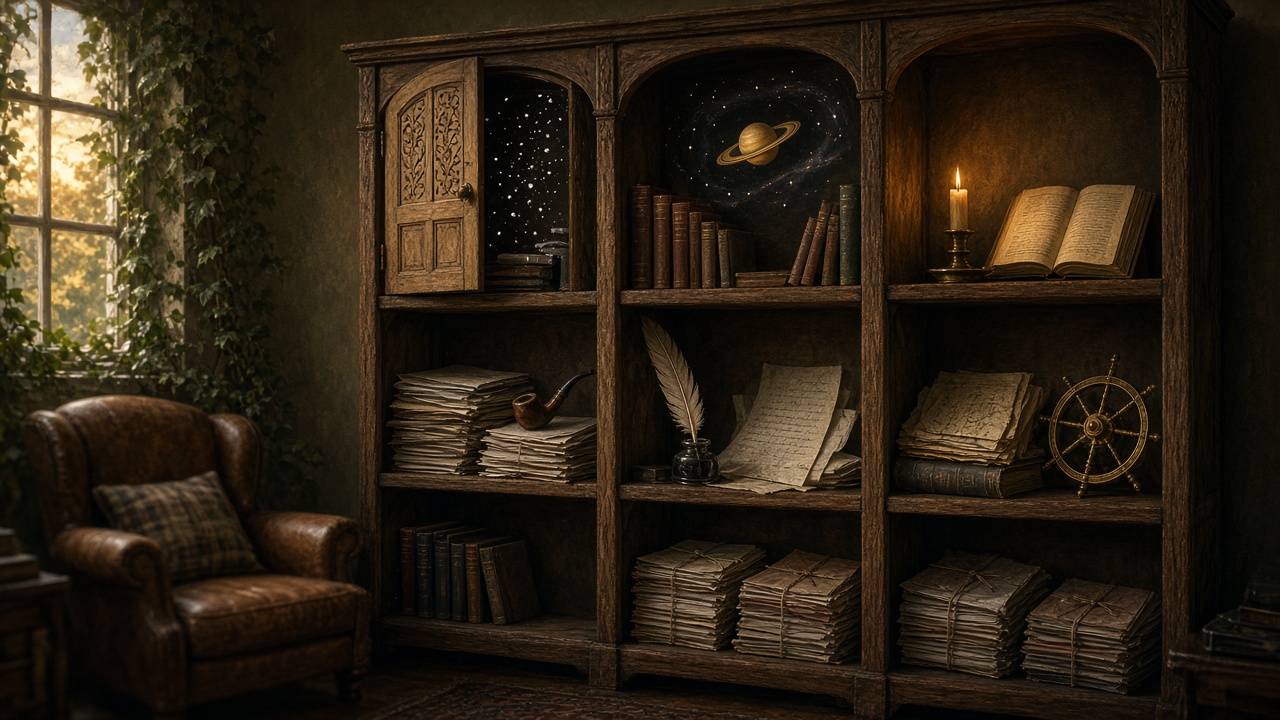
- 38 entries on his works, in seven families: Narnia, novels and stories, apologetics and spirituality, essays, poetry, literary criticism, letters and autobiography.
- For each book: the real French title, or the note 'not translated', the original title, the year, and a hook.
- The full bibliography (editions and translators) and the page 'What to read of Lewis after Narnia' complete this page.
Lewis wrote everything, or nearly: stories for children, science-fiction novels, a demon's letters, wartime sermons, scholarly treatises on medieval poetry, poems, and thousands of letters. His books are arranged here in seven families, as in a pack of cards. Each entry gives the French title (or notes that there is none), the year, the reading level, the French editions found in the catalogues, and what the book owes to Narnia, or lends to it.
The complete list, with every edition and every translator, is in the bibliography. To know where to begin, see our page What to read of Lewis after Narnia, which offers paths according to what you have liked, and a prescription according to the time of life.
Narnia
The seven Chronicles have their own section, book by book; this entry sets them back in the whole of the work.
- Le Monde de Narnia — The Chronicles of Narnia, 1950-1956: The seven Chronicles seen from their author's desk.
Novels and stories
Lewis's fiction for adults, from the allegory of 1933 to the myth of Psyche in 1956, by way of the Space Trilogy and a demon's letters: often darker and bolder than Narnia.
- Le Retour du pèlerin (title not translated) — The Pilgrim's Regress, 1933: The island glimpsed: Lewis's conversion told as allegory.
- Au-delà de la planète silencieuse — Out of the Silent Planet, 1938: Mars without hostile Martians: the novel that turns the conquest of space inside out.
- Tactique du diable — The Screwtape Letters, 1942: A demon's letters to his nephew: the bestseller that made Lewis famous.
- Perelandra — 1943: An Eve on Venus: the temptation played out again on floating islands.
- Cette hideuse puissance — That Hideous Strength, 1945: Merlin against the institute: the campus novel that turns to apocalypse.
- Le Grand Divorce — The Great Divorce, 1945: A bus to heaven: the fable in which one chooses to stay.
- Un visage pour l'éternité — Till We Have Faces, 1956: Psyche told by her sister: the last novel, and the boldest.
- Démo(n)cratiquement vôtre — Screwtape Proposes a Toast, 1959: The demons' banquet: Screwtape returns to speak of school and of equality.
- La Tour noire et autres histoires — The Dark Tower and Other Stories, 1977: The bottom of the drawer, and a chronoscope: Lewis's unfinished stories.
- Boxen (title not translated) — 1985: The attic at Little Lea: the childhood kingdom that comes before Narnia.
Apologetics and spirituality
The books in which Lewis argues or meditates: suffering, miracles, the faith explained on the radio, the Psalms, love and prayer.
- Le Problème de la souffrance — The Problem of Pain, 1940: Thinking about pain in cold blood: the book Lewis would reread in his grief.
- Miracles — 1947: The laws of nature and the deeper magic: Lewis's most philosophical essay.
- Les Fondements du christianisme — Mere Christianity, 1952: Fifteen minutes on the radio: Christianity explained to a country at war.
- Réflexions sur les Psaumes — Reflections on the Psalms, 1958: An amateur before the Psalms: praise, anger and joy.
- Les Quatre Amours — The Four Loves, 1960: Affection, friendship, eros, charity: four ways of loving, and their traps.
- Lettres à Malcolm — Letters to Malcolm, 1964: Twenty-two letters on prayer: the last Lewis, and the freest.
Essays
Lectures, sermons and articles, gathered into volumes in his lifetime or after his death.
- L'Abolition de l'homme — The Abolition of Man, 1943: Pupils without chests: the lecture that still worries educators.
- Le Poids de gloire — The Weight of Glory and Other Addresses, 1941 (sermon); 1949 (collection): 'There are no ordinary people': the sermon of a wartime evening.
- D'autres mondes (title not translated) — Of Other Worlds, 1966: It all began with an image: the essays in which Lewis tells of Narnia.
- Dieu au banc des accusés — God in the Dock, 1970: The trial turned upside down: Lewis answers the questions of his time.
- Autres recueils d'essais — 1939-1986: A hundred and twenty essays, and a compass: finding one's way among Lewis's collections.
Poetry
Lewis wanted first to be a poet: two books of his youth signed with a pseudonym, then the poems gathered after his death.
- Esprits captifs (title not translated) — Spirits in Bondage, 1919: The poems of an atheist soldier: Lewis's first book.
- Dymer (title not translated) — 1926: The poet's broken dream: Dymer, the epic that turned Lewis towards prose.
- Poèmes — 1964-2015: The poet hidden under initials: Lewis in verse.
Literary criticism
Lewis's profession, as a professor at Oxford and then at Cambridge: courtly love, Milton, the English sixteenth century, the history of words, the art of reading, and the medieval heavens.
- L'Allégorie de l'amour (title not translated) — The Allegory of Love, 1936: Troubadours, the Rose and knights: the scholarly book that launched Lewis.
- L'Hérésie personnelle (title not translated) — The Personal Heresy, 1939: Should one look for the poet in the poem? A debate in two voices.
- Préface au Paradis perdu (title not translated) — A Preface to Paradise Lost, 1942: Satan is not the hero: Lewis rereads Milton.
- La Littérature anglaise au XVIe siècle (title not translated) — English Literature in the Sixteenth Century, Excluding Drama, 1954: Seven hundred pages in the library of Narnia.
- Études sur les mots (title not translated) — Studies in Words, 1960: When words slip: Lewis the philologist.
- Expérience de critique littéraire — An Experiment in Criticism, 1961: Read well rather than judge well: the reader's little manifesto.
- L'Image du monde (title not translated) — The Discarded Image, 1964: The heavens that sing: the medieval cosmos, a key to the sky of Narnia.
Letters and autobiography
Lewis told by himself: his conversion, his grief, the diary of his youth, and thousands of letters, including those he wrote to children.
- Surpris par la joie — Surprised by Joy, 1955: An autobiography that follows a desire: from Belfast to Whipsnade Zoo.
- Apprendre la mort — A Grief Observed, 1961: Four notebooks against the silence: Lewis's grief without disguise.
- Journal 1922-1927 (title not translated) — All My Road Before Me, 1991: The notebook of a hard-up atheist: Lewis at Oxford before the fame.
- Lettres à une Américaine — Letters to an American Lady, 1967: Thirteen years of letters to a stranger: Lewis's quiet generosity.
- Lettres du pays de Narnia — C.S. Lewis: Letters to Children, 1985: 'Do not say that it is terrible; make it terrible': Lewis replies to children.
- Correspondance complète (title not translated) — The Collected Letters of C.S. Lewis (3 volumes), 2000-2006: Three thousand pages of letters: the autobiography Lewis did not set out to write.
How to read these entries
- When a title is followed by 'title not translated', no French translation has been found in the catalogues of the BnF, the SUDOC and the Swiss National Library; the French title serves only to show what the book is about.
- The reading level runs from 'Easy' to 'Demanding'. It says what effort is asked, not how interesting the book is.
- Availability in the bookshops changes quickly: each entry gives the date of its survey.
- Some titles in the bibliography have no entry of their own (Broadcast Talks, taken up into Mere Christianity; Arthurian Torso, written with Charles Williams; the essays in The World's Last Night, presented in the entry on the other collections of essays).
- groups —
- Narnia — introduction: The seven Chronicles have their own section, book by book; this entry sets them back in the whole of the work.
- Novels and stories — introduction: Lewis's fiction for adults, from the allegory of 1933 to the myth of Psyche in 1956, by way of the Space Trilogy and a demon's letters: often darker and bolder than Narnia.
- Apologetics and spirituality — introduction: The books in which Lewis argues or meditates: suffering, miracles, the faith explained on the radio, the Psalms, love and prayer.
- Essays — introduction: Lectures, sermons and articles, gathered into volumes in his lifetime or after his death.
- Poetry — introduction: Lewis wanted first to be a poet: two books of his youth signed with a pseudonym, then the poems gathered after his death.
- Literary criticism — introduction: Lewis's profession, as a professor at Oxford and then at Cambridge: courtly love, Milton, the English sixteenth century, the history of words, the art of reading, and the medieval heavens.
- Letters and autobiography — introduction: Lewis told by himself: his conversion, his grief, the diary of his youth, and thousands of letters, including those he wrote to children.
- total — 38
- note — Data for a filterable page (genre, level, availability); the order of the families and of the entries follows navigation.json.
See also
- Bibliography of C.S. Lewis
- What to read of Lewis after Narnia
- The Chronicles of Narnia (the seven Chronicles)
- The Pilgrim's Regress (title not published in French)
- Out of the Silent Planet
- The Screwtape Letters
- Perelandra
- That Hideous Strength
- The Great Divorce
- Till We Have Faces
- Screwtape Proposes a Toast
- The Dark Tower and Other Stories
- Boxen (title not translated)
- The Problem of Pain
- Miracles
- Mere Christianity
- Reflections on the Psalms
- The Four Loves
- Letters to Malcolm
- The Abolition of Man
- The Weight of Glory
- Of Other Worlds: essays and stories (title not translated)
- God in the Dock
- Other collections of essays
- Spirits in Bondage (title not translated)
- Dymer (not translated)
- Poems (posthumous collections)
- The Allegory of Love (title not translated into French)
- The Personal Heresy (title not translated)
- A Preface to Paradise Lost (title not translated into French)
- English Literature in the Sixteenth Century (title not translated into French)
- Studies in Words (title not translated)
- An Experiment in Criticism
- The Discarded Image (title not translated into French)
- Surprised by Joy
- A Grief Observed
- All My Road Before Me (title not translated)
- Letters to an American Lady (usual title)
- Letters to Children: C.S. Lewis writes to children
- The Collected Letters of C.S. Lewis (not translated)
- A commented bibliography: reading about Narnia and about Lewis
- From Neuchâtel to our bookshops: eighty years of Lewis in French, and the books that are still missing
- C.S. Lewis, more than Narnia