The seven Chronicles of Narnia
Seven novels published in seven years, translated into nearly fifty languages and sold in more than a hundred million copies: the series at a glance.
Seven doors
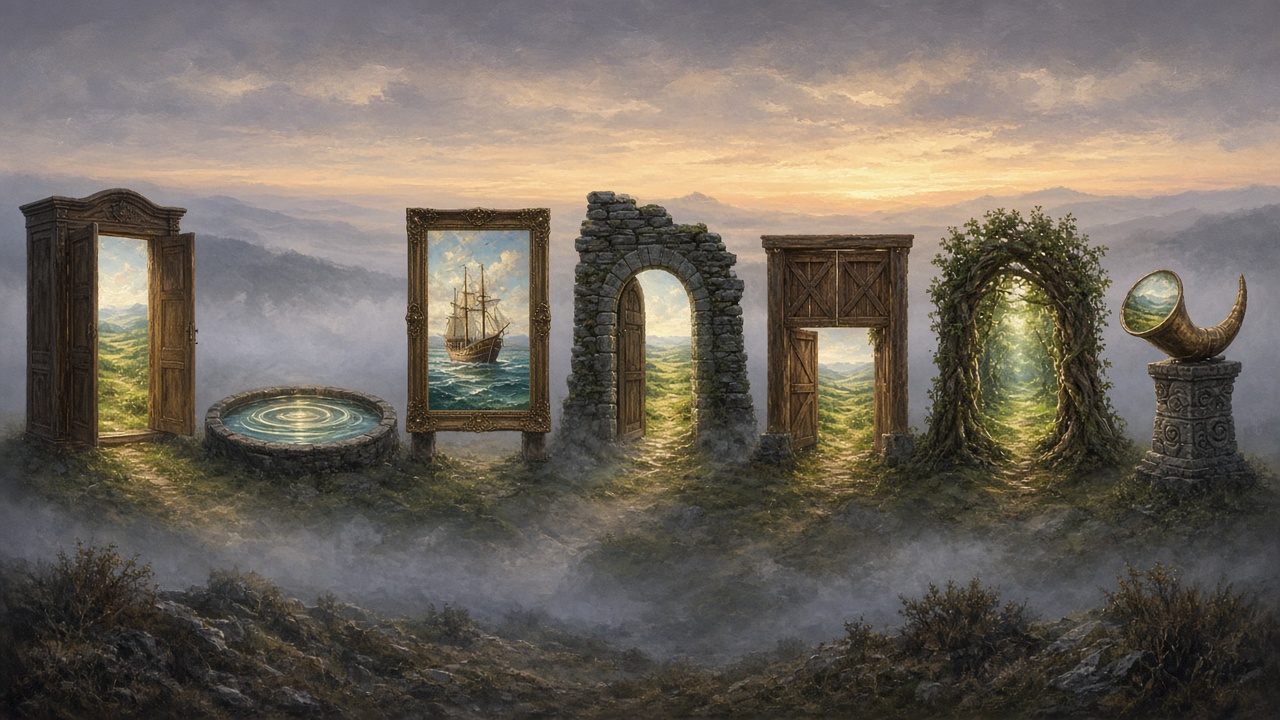
- 7 volumes, published from 1950 to 1956.
- The order of publication differs from the chronological order.
- Original illustrations by Pauline Baynes.
Between 1950 and 1956, C.S. Lewis published one Narnia novel a year. Nothing had been planned in advance: the author wrote The Lion, the Witch and the Wardrobe without knowing there would be a sequel, and several times he thought he had finished. And so the series was born, one book after another. That is why the order of publication differs from the chronological order of the story, which French editions follow today. The table below follows the order of the story; the year of publication is given for each volume, and the debate is summed up in Which order to read the Chronicles?.
- No. (order of the story) — French title — Original title — Publication (rank) — Narnian era
- 1 — Le Neveu du magicien — The Magician's Nephew — 1955 (6th) — year 1
- 2 — Le Lion, la Sorcière blanche et l'Armoire magique — The Lion, the Witch and the Wardrobe — 1950 (1st) — 1000-1015
- 3 — Le Cheval et son écuyer — The Horse and His Boy — 1954 (5th) — 1014
- 4 — Le Prince Caspian — Prince Caspian — 1951 (2nd) — 2303
- 5 — L'Odyssée du Passeur d'Aurore — The Voyage of the Dawn Treader — 1952 (3rd) — 2306-2307
- 6 — Le Fauteuil d'argent — The Silver Chair — 1953 (4th) — 2356
- 7 — La Dernière Bataille — The Last Battle — 1956 (7th) — 2555
Pauline Baynes's illustrations
Every volume was illustrated by Pauline Baynes, a young artist Lewis had discovered through the drawings she had made for a tale by Tolkien, Farmer Giles of Ham. Her pen drawings, and later the colours added for more recent editions, are part of the identity of the series.
In French
The first two volumes appeared from Hachette as early as 1952 and 1953, then four volumes from Flammarion between 1980 and 1984, under other titles. Gallimard Jeunesse at last published the whole series, in chronological order, from 2001, with the translations of Anne-Marie Dalmais (taken over from Flammarion for the first two volumes), of Cécile Dutheil de la Rochère and of Philippe Morgaut, then a complete edition in one volume in 2005. The old translation and the new one do not always give the characters the same name: our entries always give both. The whole story is told in The French editions of Narnia.
The seven books, one by one
Arranged in the order of the story; the year is the first publication in Great Britain.
- The Magician's Nephew (1955, 6th to appear)
- The Lion, the Witch and the Wardrobe (1950, 1st to appear)
- The Horse and His Boy (1954, 5th to appear)
- Prince Caspian (1951, 2nd to appear)
- The Voyage of the Dawn Treader (1952, 3rd to appear)
- The Silver Chair (1953, 4th to appear)
- The Last Battle (1956, 7th to appear)
Around the books
- How Lewis created Narnia
- The name 'Narnia' and the town of Narni
- Pauline Baynes, the original illustrator
- The French editions of Narnia
- Narnia around the world: languages and translations
- From Puddleglum to Puddlegum: what the names of Narnia say in English, and what they become in French
- And, to choose where to begin: Which order to read the Chronicles of Narnia?
See also
- Which order to read the Chronicles of Narnia?
- The Magician's Nephew
- The Lion, the Witch and the Wardrobe
- The Horse and His Boy
- Prince Caspian
- The Voyage of the Dawn Treader
- The Silver Chair
- The Last Battle
- How Lewis created Narnia
- The name 'Narnia' and the town of Narni
- Pauline Baynes, the original illustrator
- The French editions of Narnia
- Narnia around the world: languages and translations
- From Puddleglum to Puddlegum: what the names of Narnia say in English, and what they become in French
- The great register of characters
- The world of Narnia
- The Chronicles of Narnia (the seven Chronicles)