The Great Divorce
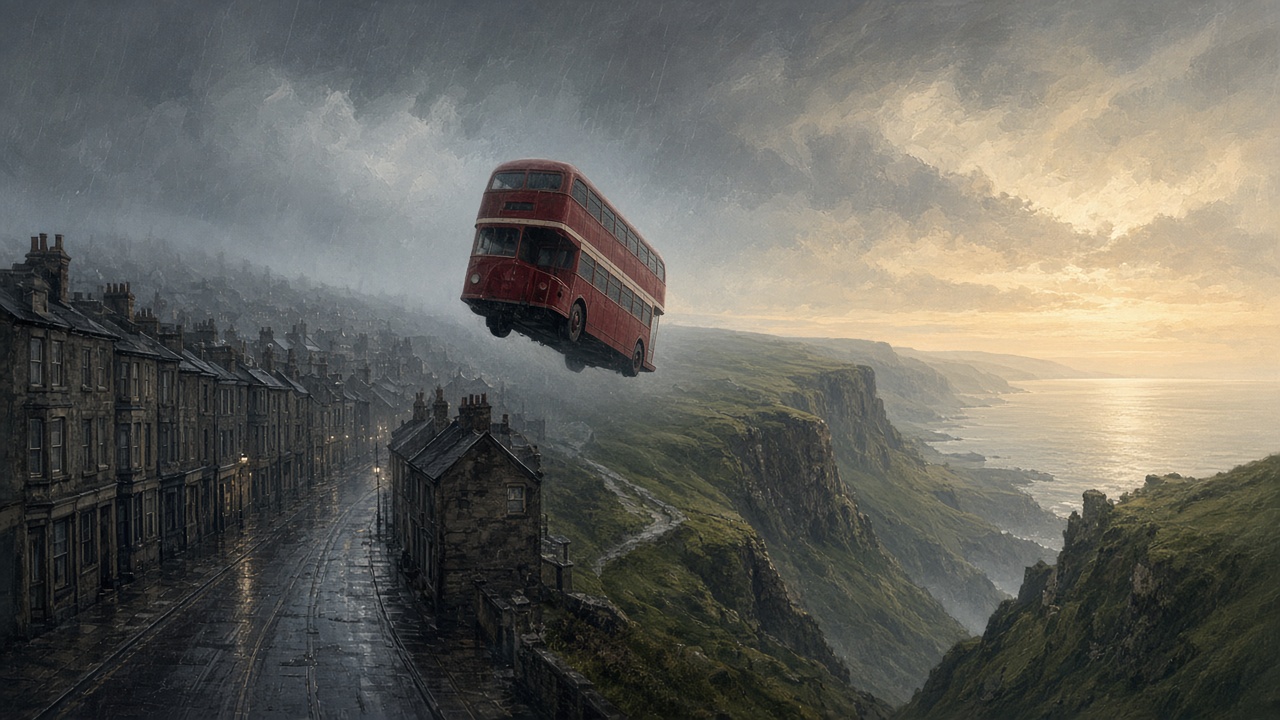
An bus shuttles between a gray and rainy city and the luminous outskirts of paradise. The passengers can stay, on one condition: let go of what holds them back. Almost none do.
The narrator stands in line in the rain, in a twilight city where the houses are empty and everyone distances themselves from their neighbors. He boards a flying bus that takes him to a countryside so real that the grass hurts the travelers’ feet: these are ghosts, transparent, facing solid and radiant beings who come to meet them. Each ghost is visited by someone they knew, who invites them to stay. But each has a good reason to leave: a bishop who prefers his debates of ideas to the truth, a mother who demands her son, an artist who is only interested in his reputation, a man who refuses to let go of the little red lizard perched on his shoulder. The narrator is guided by the Scottish writer George MacDonald, his mentor, who explains what he sees. One of the most famous scenes features a simple woman from the London suburbs, greeted as a queen.
- Original title — The Great Divorce
- First published — 1945
- Genre — Visionary tale, fable
- First English edition — Geoffrey Bles, London, 1945 (serial in The Guardian, 1944-1945)
- Availability in bookstores — Available (Empreinte temps présent, 2025, under the title L'Autobus du paradis).
- Reading level — Easy — a short tale
- For whom — Perfect after *The Screwtape Letters*. Can be read in one evening.
- Year — 1945
Other French titles
- Le Grand Divorce entre le ciel et la terre
- L'Autobus du paradis
[{title, publisher, year, translator?, note?, source?}]
- The Great Divorce between heaven and earth — Delachaux et Niestlé — Neuchâtel / Paris — 1947 — Geneviève Teyssonnière de Gramont and Jacqueline Des Gouttes — translation revised by the author
- L'Autobus du paradis — Éditions du Cerf — Paris — 1980 — Jacques Winandy and Dominique Barrios-Delgado — new title
- The Great Divorce between heaven and earth — Raphaël — Le Mont-Pèlerin — 1998 — reprinted around 2006; uncertain translator, catalogues contradict each other (SUDOC lists Denis Ducatel, Geneviève Teyssonnière de Gramont, which is a reissue of the 1947 translation)
- L'Autobus du paradis — Empreinte temps présent — 2025 — completely revised new edition, April 2025
themes
- Hell is a door locked from the inside.
- Freedom to choose, until the end.
- Possessive love opposed to true love.
- The solid reality of heaven compared to earth.
- Transformation: the lizard becomes a stallion.
Short quotes with source
- There are only two kinds of people: those who say to God, ‘Thy will be done,’ and those to whom God says, at last, ‘Thy will be done.’ — The Great Divorce, ch. 9 — website translation
Family
Novels and tales
Other names
- The Great Divorce
- Le Grand Divorce entre le ciel et la terre
- L'Autobus du paradis
- Visionary tale, fable
- Fiction
An bus shuttles between a gray and rainy city and the luminous outskirts of paradise. The passengers can stay, on one condition: let go of what holds them back. Almost none do.
Quick facts
## How to approach it Niveau: Easy — a short story. Perfect after *The Screwtape Letters*. Can be read in one evening. ## The book in a few lines The narrator waits in line in a twilight city where the houses are empty and everyone avoids their neighbors. He boards a flying bus that takes him to a countryside so real that the grass hurts the travelers’ feet: they are ghosts, transparent, facing solid and radiant people who come to meet them. Each ghost is visited by someone they once knew, who invites them to stay. But each has a good reason to leave: a bishop who prefers his debates of ideas to the truth, a mother who demands her son, an artist who cares only about his reputation, a man who won’t let go of the little red lizard perched on his shoulder. The narrator is guided by the Scottish writer George MacDonald, his mentor, who explains what he sees. One of the most famous scenes features a simple suburban woman welcomed as a queen. ## In Lewis’s workshop The title responds to *The Marriage of Heaven and Hell* by the poet William Blake: for Lewis, heaven and hell cannot be married; one must choose. He also draws on a medieval idea that the damned could sometimes enjoy “vacations.” The book was first published in serial form under the title *Who Goes Home?*. ## What announces Narnia The “more real than real” countryside is that of the land of Aslan at the end of *The Last Battle* (“higher and further”). The dwarfs who refuse to see the feast are cousins of the ghosts in *The Great Divorce*. ## What today’s reader retains Each of the ghosts refuses paradise for reasons familiar to us: resentment, reputation, possessive love, love of debate. This is what makes the book so relevant: it is not primarily about the afterlife, but about what we refuse to let go of in this life. Lewis himself reminded us: it is not a description of what awaits us. ## The trace it has left One of Lewis’s most beloved books, often recommended to those who question the afterlife. Lewis clarifies in his preface that it is fiction and not a description of what awaits us. ## Key ideas to remember- Hell is a door shut from the inside.
- Freedom to choose, even at the last moment.
- Possessive love opposed to true love.
- Heaven’s reality is more solid than earth’s.
- The transformation: the red lizard becomes a stallion.
## Read it in French“There are only two kinds of people: those who say to God ‘Thy will be done,’ and those to whom God says, at last, ‘Thy will be done.’”
— *The Great Divorce*, ch. 9 — translation from the website
- *Le Grand Divorce entre le ciel et la terre*, Delachaux et Niestlé, Neuchâtel / Paris, 1947, trans. Geneviève Teyssonnière de Gramont and Jacqueline Des Gouttes — translation revised by the author
- *L’Autobus du paradis*, Éditions du Cerf, Paris, 1980, trans. Jacques Winandy and Dominique Barrios-Delgado — new title
- *Le Grand Divorce entre le ciel et la terre*, Raphaël, Le Mont-Pèlerin, 1998 — reprinted around 2006; translator uncertain, catalogs contradict each other (SUDOC lists Denis Ducatel, swisscovery Geneviève Teyssonnière de Gramont, i.e., a reprint of the 1947 translation)
- *L’Autobus du paradis*, Empreinte temps présent, 2025 — fully revised edition, April 2025
Stage adaptations (including by Max McLean’s company). A film project has been announced several times without coming to fruition.
## See also ## Sources
Échanges entre lecteurs
Une question, un souvenir de lecture, une idée ? Partagez-les avec les autres lecteurs, dans le respect de la charte des commentaires.
Les commentaires ne sont pas disponibles pour le moment.
Les commentaires sont fermés sur cette page.
Aucun commentaire pour le moment. Soyez la première personne à partager votre avis !
Merci ! Votre commentaire sera visible après relecture.