The Dark Tower and Other Tales
An unfinished time-travel novel, some fantasy stories, and an astronaut tale: Lewis’s lesser-known works, published after his death and surrounded by much controversy.
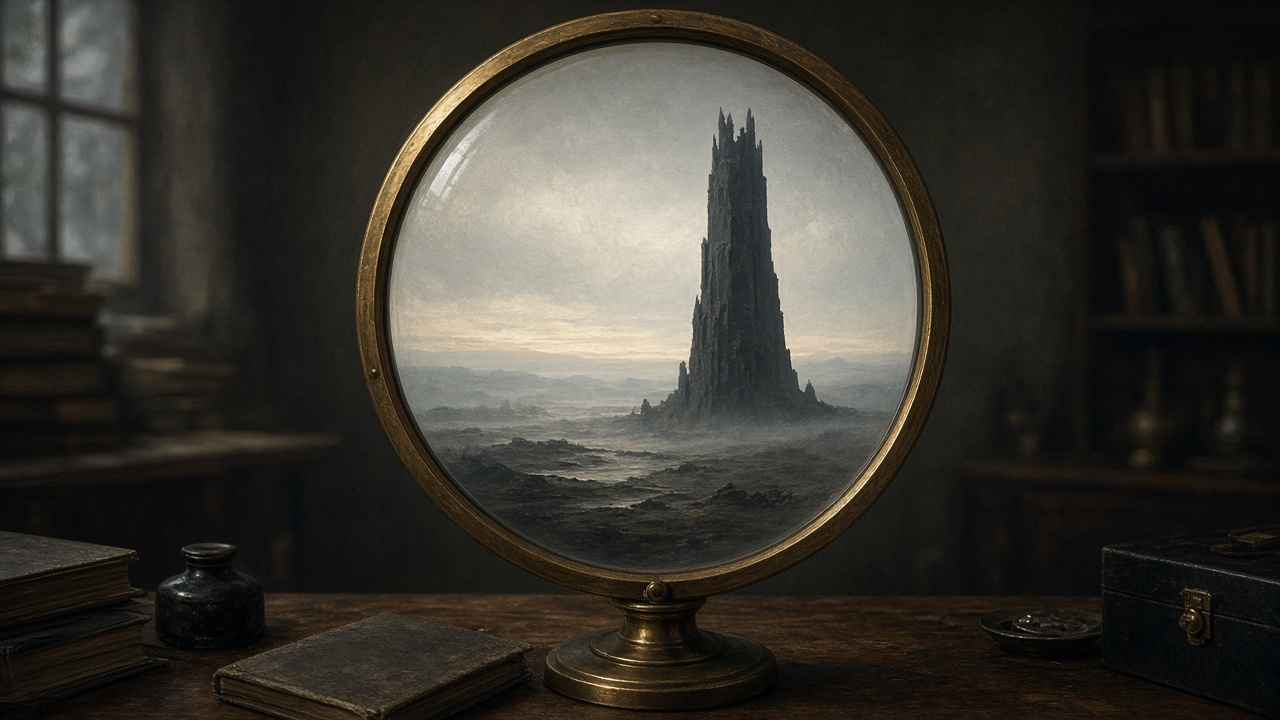
The main text, The Dark Tower, features Cambridge academics, including Ransom, who observe with a “chronoscope” another time where a sinister tower houses a man with a venomous horn who turns his victims into automatons. The story breaks off in mid-mystery. It is followed by short stories: The Man Who Had Never Seen (The Magician’s Nephew), about a man who regains his sight and seeks to understand what light is; The Shoddy Lands, where the narrator finds himself inside the shallow mind of a young woman; Ministering Angels, a satire about women sent to Mars to “distract” astronauts; Forms of Things Unknown, a lunar exploration story; and After Ten Years, the beginning of a novel about Menelaus and Helen after the Trojan War.
- Original title — The Dark Tower and Other Stories
- First English publication — 1977
- Genre — Posthumous collection of short stories and unfinished novels
- First English edition — Collins, London, 1977, ed. Walter Hooper
- Availability in bookstores — Available (Antigone14, 2020).
- Reading level — Intermediate
- For whom — For readers already familiar with Lewis, curious about his experiments. Not a starting point.
- Year — 1977
Other French titles
- The Dark Tower (alternative translation)
[{title, publisher, year, translator?, note?, source?}]
- The Dark Tower and Other Stories — Antigone14 — 2020 — Bertrand Augier — preface by Walter Hooper
themes
- Time and its mysteries.
- Perception: truly seeing.
- Humor and satire.
- Greek myth revisited.
Family
Novels and short stories
Other names
- The Dark Tower and Other Stories
- The Dark Tower
- Posthumous collection of short stories and unfinished novels
- Fiction
An unfinished time-travel novel, some fantasy stories, and an astronaut tale: Lewis’s lesser-known works, published after his death and surrounded by much controversy.
Quick facts
How to approach it
Level: Intermediate. For readers already familiar with Lewis, curious about his experiments. Not a starting point.
The book in a few words
The main text, The Dark Tower, features Cambridge academics, including Ransom, who observe through a "chronoscope" another time in which a sinister tower houses a man with a venomous horn who turns his victims into automatons. The story breaks off in mid-mystery. Then follow short stories: The Man Who Never Saw (The Man Born Blind), about a man who regains his sight and seeks what light is; The Shoddy Lands (The Shoddy Lands), where the narrator finds himself inside the superficial mind of a young woman; Ministering Angels, a satire about women sent to Mars to "entertain" the astronauts; Forms of Things Unknown, a story of lunar exploration; and After Ten Years, the beginning of a novel about Menelaus and Helen after the Trojan War.
In Lewis's workshop
The Dark Tower was probably begun around 1938-1939, perhaps as a sequel to Out of the Silent Planet in response to a challenge from Tolkien about time travel. Walter Hooper, Lewis's secretary late in life, claimed to have saved the manuscript from a fire of papers lit by Warnie after his brother's death.
What it foreshadows about Narnia
After Ten Years and The Man Who Never Saw share with Narnia the question of what is real and what one refuses to see.
What a modern reader retains
These unfinished texts mainly interest those who like to see a writer at work: a novel that breaks off, short stories of ideas, science-fiction experiments. The modern reader will also find a case study on how posthumous works are published, and sometimes discussed, of a famous author.
The trace it has left
In the 1970s-1980s, the American writer Kathryn Lindskoog contested the authenticity of The Dark Tower and accused Hooper of forgery. The controversy was lively. The manuscript, preserved in the Bodleian Library in Oxford, has since been examined, and most scholars now consider it authentic, although the story of the "fire" remains unverifiable.
Key ideas to remember
- The mysteries of time.
- Perception: truly seeing.
- Humor and satire.
- The Greek myth revisited.
Read it in French
- La Tour noire et autres histoires, Antigone14, 2020, trad. Bertrand Augier — preface by Walter Hooper
See also
- Out of the Silent Planet
- A Medievalist Among the Pulps: Lewis, Arthur C. Clarke, and the Space Debate
- The Bronze Timbals Controversy: What Has Been Done with Lewis Since 1963
Sources
- https://fr.wikipedia.org/wiki/C._S._Lewis
- https://en.wikipedia.org/wiki/The_Dark_Tower_(C._S._Lewis_novel)
- https://www.noosfere.org/books/niourf.asp?numlivre=2146619082
Échanges entre lecteurs
Une question, un souvenir de lecture, une idée ? Partagez-les avec les autres lecteurs, dans le respect de la charte des commentaires.
Les commentaires ne sont pas disponibles pour le moment.
Les commentaires sont fermés sur cette page.
Aucun commentaire pour le moment. Soyez la première personne à partager votre avis !
Merci ! Votre commentaire sera visible après relecture.