The World of Narnia
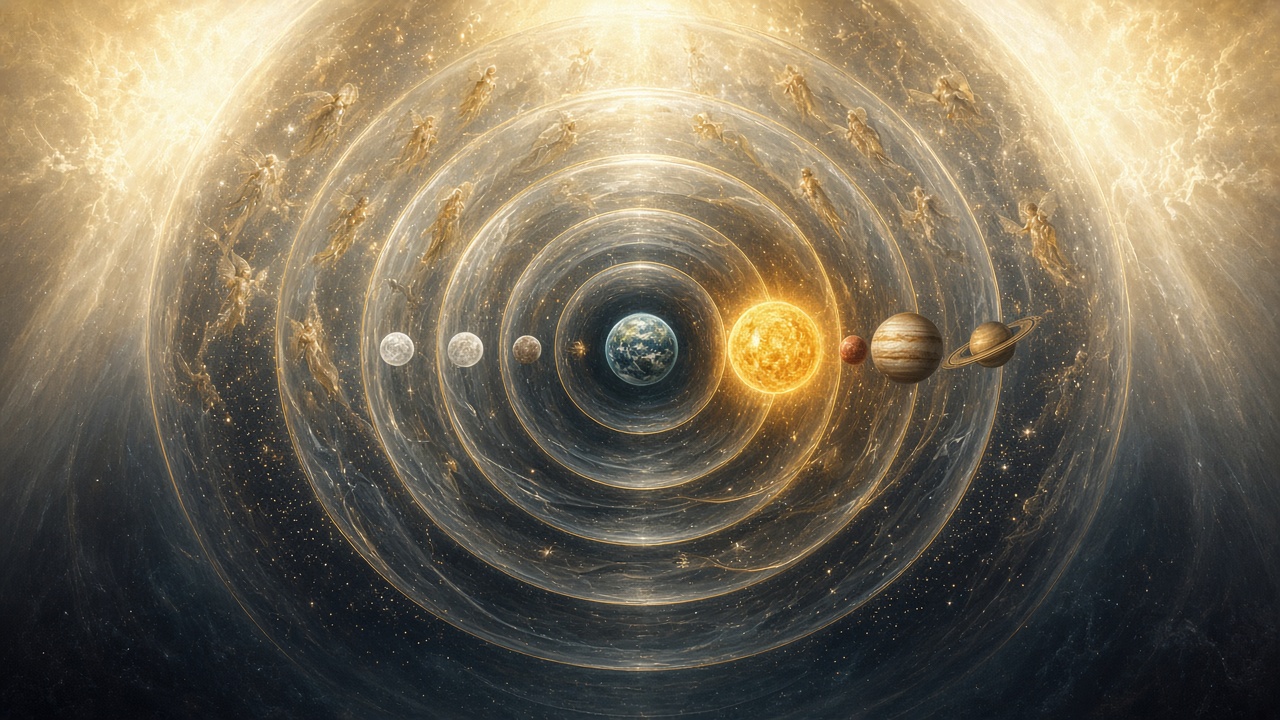
The medieval sky, its singing spheres, its planets influencing characters, its fairies and angels: Lewis reconstructs the "Model" of the world that medieval authors believed in. The key to Narnia's cosmology.
To understand Dante or Chaucer, says Lewis, one must know how they imagined the universe. He describes this "Model": a small, low Earth at the center, surrounded by transparent spheres carrying the Moon, Mercury, Venus, the Sun, Mars, Jupiter, and Saturn, then the stars and the First Mover, beyond which is God. A full, luminous, musical universe, where one looks "upwards" rather than into the void.
He presents the sources (Plato, Boethius, Macrobius), the intermediate beings, the "longaevi" (fairies, nymphs), the seven planets and their influences, the humors of the body, the liberal arts. He concludes that this Model was not "false" in the naive sense: each era has its own, and ours will pass too.
- Original title
- First published
- Genre
- First English edition
- Availability in bookstores
- In brief
- For whom
- Year
Other medieval titles
- The Abandoned Image (literal translation)
themes
- The medieval cosmos as a cathedral.
- The seven planets and their characters.
- Each era has its own model of the world.
- Imagination and science.
Family
Literary criticism
Other names
- The Discarded Image: An Introduction to Medieval and Renaissance Literature
- The Abandoned Image (literal translation)
- Literary criticism
The medieval sky, its singing spheres, its planets influencing characters, its fairies and angels: Lewis reconstructs the "Model" of the world that medieval authors believed in. The key to Narnia's cosmology.
Quick facts
How to approach it
Level: Intermediate — clear and fascinating. For readers curious about the Middle Ages and those who want to understand the sky of Narnia, in English.
About the book in a few lines
To understand Dante or Chaucer, says Lewis, one must know how they imagined the universe. He describes this "Model": a small, low Earth at the center, surrounded by transparent spheres carrying the Moon, Mercury, Venus, the Sun, Mars, Jupiter, and Saturn, then the stars and the First Mover, beyond which is God. A full, luminous, musical universe, where one looks "upwards" rather than into the void.
He presents the sources (Plato, Boethius, Macrobius), the intermediate beings, the "longaevi" (fairies, nymphs), the seven planets and their influences, the humors of the body, the liberal arts. He concludes that this Model was not "false" in the naive sense: each era has its own, and ours will pass too.
In Lewis's workshop
This book is based on an introductory lecture course that Lewis gave for many years at Oxford and then at Cambridge. It was published a few months after his death.
What announces Narnia
The living stars (Ramandu, Coriakin), the planets Tarva and Alambil that meet in the sky of Prince Caspian, the dance of the stars at the end of The Last Battle: everything comes from this Model.
What a modern reader retains
The modern reader, used to an empty and cold universe, discovers through Lewis that one could look at the sky as a home full of light and music. The book's conclusion is one of great modesty: our own image of the world will pass too. It is an excellent lesson against "chronological snobbery."
Lewis's legacy
Still recommended to students. In 2008, researcher Michael Ward (Planet Narnia) proposed a famous hypothesis: each of the seven Chronicles would be placed under the sign of one of the seven medieval planets (Jupiter for The Lion, Mars for Prince Caspian, the Sun for The Voyage of the Dawn Treader, etc.). A seductive hypothesis, discussed, but unproven.
Key ideas to remember
- The medieval cosmos as a cathedral.
- The seven planets and their characters.
- Each era has its own model of the world.
- Imagination and science.
See also
- The Allegory of Love
- The world of Narnia
- Jack's Lexicon: twelve ideas from Lewis and the scene in Narnia that illustrates them
- Coriakin, the magician of the Island of Voices
Sources
- https://en.wikipedia.org/wiki/The_Discarded_Image
- https://en.wikipedia.org/wiki/Planet_Narnia
Échanges entre lecteurs
Une question, un souvenir de lecture, une idée ? Partagez-les avec les autres lecteurs, dans le respect de la charte des commentaires.
Les commentaires ne sont pas disponibles pour le moment.
Les commentaires sont fermés sur cette page.
Aucun commentaire pour le moment. Soyez la première personne à partager votre avis !
Merci ! Votre commentaire sera visible après relecture.