The Abolition of Man
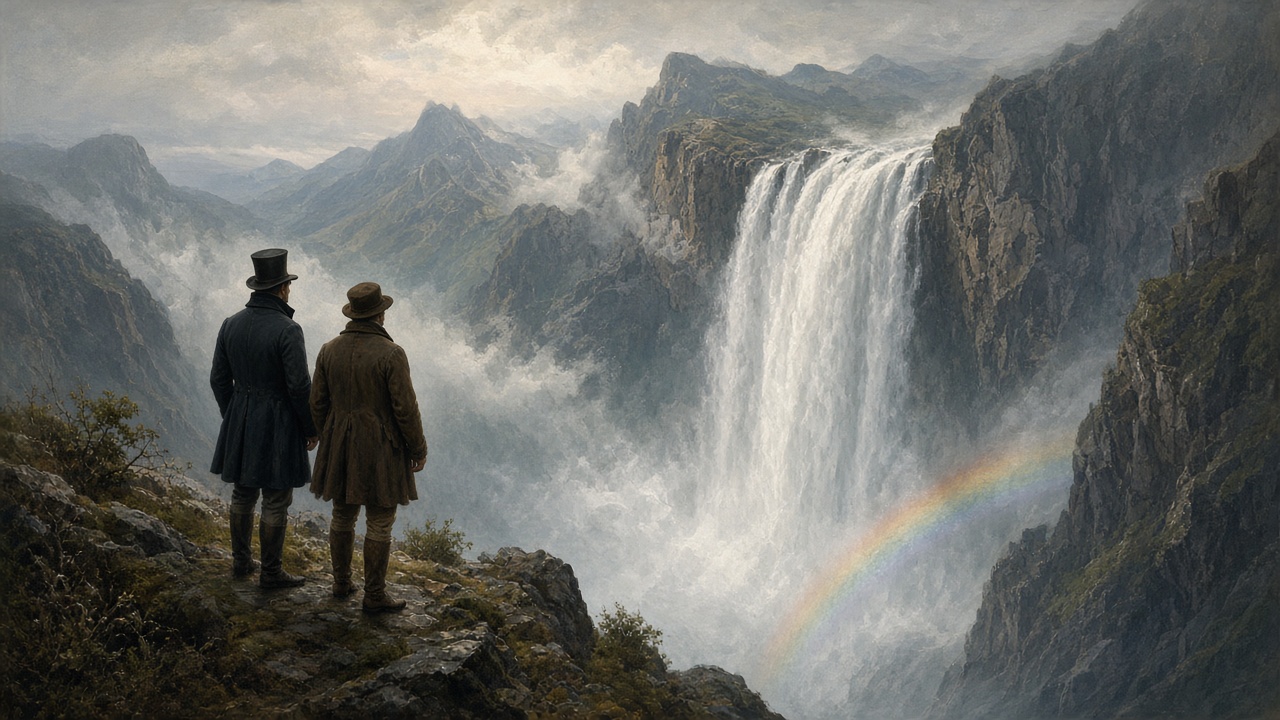
In brief, a sublime waterfall, and a dizzying question: if we teach children that all values are merely feelings, who will decide tomorrow what it means to be human? A short book often cited far beyond Christian circles.
[{title, publisher, year, translator?, note?, source?}]
- L'Abolition de l'homme : réflexions sur l'éducation — A. Ardant-Criterion — Limoges — 1986 — Irène Fernandez — first translation, with a preface by the translator
- L'Abolition de l'homme — Raphaël — Le Mont-Pèlerin — 2000 — Denis Ducatel — Denis Ducatel, the translator, headed Éditions Raphaël
- The Abolition of Man: The Way We Lost It — Ad Solem — Paris — 2017 — Irène Fernandez — based on the 1986 translation (the SUDOC also lists a 2015 reprint)
Going further
- « Men without chests »: educating the feelings.
- The Tao: a universal moral law.
- The dangers of conditioning and technocracy.
- Science, its powers and its limits.
In brief, a sublime waterfall, and a dizzying question: if we teach children that all values are merely feelings, who will decide tomorrow what it means to be human? A short book often cited far beyond Christian circles.
Short quotes with source
- We make men without chests and expect of them virtue and enterprise. — The Abolition of Man, ch. 1 — website translation
Home
Essays
Other names
- The Abolition of Man
- Essay (moral philosophy, education)
- Essays
Quick facts
## How to Approach ItIn Brief
Intermediate level — short but dense. For teachers, students, and anyone passionate about educational issues. Three chapters, about a hundred pages.
## Did You KnowThe Story in a Few Words
Lewis starts with a high school English textbook, which he discreetly calls "the Green Book." The authors comment on an anecdote: in front of a waterfall, one tourist says it is "sublime," another "pretty." For the textbook, these sentences say nothing about the waterfall, only about the emotions of the speakers. Lewis sees this as a quiet revolution: we are raising students without "chests," that is, without educated emotions that connect intellect to instincts. He defends the existence of an objective morality, which he calls the Tao, common to all great civilizations; he gives examples in an appendix, drawn from Egyptian, Babylonian, Chinese, Greek, Norse, and Hebrew texts. The final lecture describes the logical outcome of rejecting all values: a handful of "conditioners" who, armed with science, would shape future generations according to their whims. The conquest of nature by man would become the conquest of man by nature.
## On ScreenIn Lewis's Workshop
The book was written in the middle of the war against totalitarian regimes that claimed to be able to manufacture a new kind of man. That same year, Lewis wrote a novel, The Magician's Nephew. He does not target science as such, but a philosophy that reduces everything to measurable facts.
What Foreshadows Narnia
The experimental school in The Silver Chair, and Uncle Andrew from The Magician's Nephew, a scientist willing to sacrifice guinea pigs in the name of science, are illustrations of Narnia that Lewis uses.
## Going FurtherWhat a Modern Reader Should Know
Written in 1943, before modern genetics and artificial intelligence, the book's final question (who will shape the human of tomorrow, and according to what values?) is posed today with renewed urgency. One may not share the notion of the Tao and still recognize the strength of the warning.
## TriviaThe Legacy of the Book
Lewis considered this one of his most important books. It is cited today in debates on education, bioethics, genetic engineering, and transhumanism, by both believing and non-believing authors. In 2020, the French publisher Téqui published a commentary by Michael Aeschliman, La Restauration de l'homme.
## Ideas to RememberKey Takeaways
- Men Without Chests: the education of feelings.
- The Tao: a universal moral law.
- The dangers of conditioning and technocracy.
- Science, its powers and its limits.
“We are making men without chests and we expect them to be virtuous and to have a spirit of enterprise.”
— The Abolition of Man, ch. 1 — translation from the website
Read It in French
- The Abolition of Man: Reflections on Education, A. Ardant-Criterion, Limoges, 1986, trans. Irène Fernandez — first translation, with a preface by the translator
- The Abolition of Man, Raphaël, Le Mont-Pèlerin, 2000, trans. Denis Ducatel, director of Éditions Raphaël
- The Abolition of Man: The Way We Lost It, Ad Solem, Paris, 2017, trans. Irène Fernandez — reissue of the 1986 translation (the SUDOC also lists a printing dated 2015)
See Also
- The Lion, the Witch and the Wardrobe
- The Last Battle: A Medievalist in Oxford and Cambridge, and What Narnia Owes to His Library
- The Narnia Code: Twelve Ideas from Lewis and the Scene in Narnia That Shows Them
- Aslan
Échanges entre lecteurs
Une question, un souvenir de lecture, une idée ? Partagez-les avec les autres lecteurs, dans le respect de la charte des commentaires.
Les commentaires ne sont pas disponibles pour le moment.
Les commentaires sont fermés sur cette page.
Aucun commentaire pour le moment. Soyez la première personne à partager votre avis !
Merci ! Votre commentaire sera visible après relecture.