Boxen
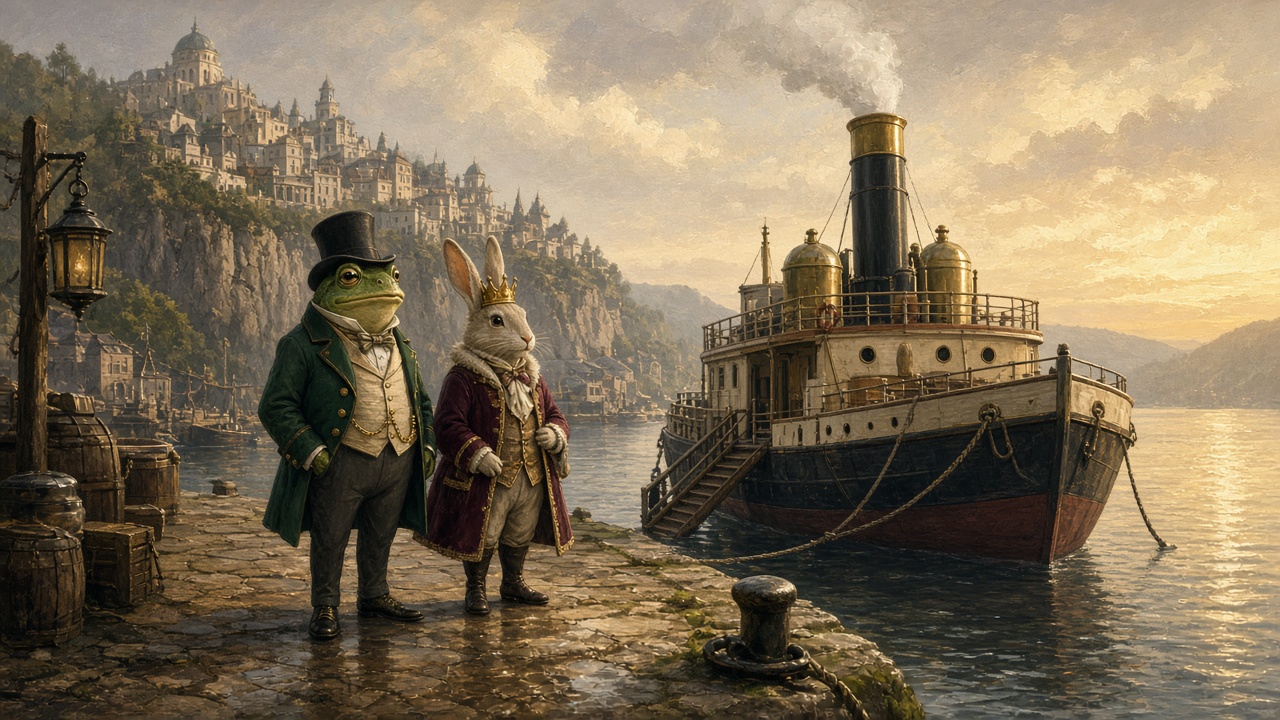
Before Narnia, there was Boxen: a kingdom of talking animals, complete with kings, trains, newspapers, and parliamentary intrigue, invented by Jack and his brother Warnie in the attic of Little Lea.
Young Jack created Animal-Land, populated by mouse knights and costumed animals; Warnie, who loved trains and boats, created India. The two worlds merged into Boxen, with a capital, a parliament, a rabbit king, and a frog Prime Minister, Lord John Big, a pompous and magnificent character. The stories involve plots, steamboat journeys, political disputes, and grand dinners. The collection brings together the main tales, maps, and drawings by the child.
- Original title — Boxen: The Imaginary World of the Young C.S. Lewis
- First appearance — 1985
- Genre — Early works (stories, chronicles, drawings)
- First English edition — Collins, London, 1985, ed. Walter Hooper (texts written around 1906-1913)
- Availability in bookstores — Not translated into French.
- Reading level — Easy — curiosity
- For whom — For those curious about Lewis’s childhood, in English. Year — 1985
Themes
- The invention of a complete world, with its own history and geography.
- Childish satire of the adult world (politics, social events).
- The complicity between two brothers.
Family
Novels and stories
Other names
- Boxen: The Imaginary World of the Young C.S. Lewis
- Early works (stories, chronicles, drawings)
- Fiction
Before Narnia, there was Boxen: a kingdom of talking animals, complete with kings, trains, newspapers, and parliamentary intrigue, invented by Jack and his brother Warnie in the attic of Little Lea.
In brief
How to approach it
Level: Easy — curiosity. For those curious about Lewis’s childhood, in English.
The book in a few lines
Young Jack created Animal-Land, populated by mouse knights and costumed animals; Warnie, who loved trains and boats, created India. The two worlds merged into Boxen, with a capital, a parliament, a rabbit king, and a frog Prime Minister, Lord John Big, a pompous and magnificent character. The stories involve plots, steamboat journeys, political disputes, and grand dinners. The collection brings together the main tales, maps, and drawings by the child.
In Lewis’s workshop
The texts were written between about six and fifteen years old. Lewis would later remark in Surprised by Joy that Boxen contained no poetry, no “Joy”: it was a world of plots, not wonders. Narnia would be its exact opposite.
What announces Narnia
Talking animals organized into society are the distant ancestor of the Beavers and Reepicheep. But Lewis insists: Narnia does not come from Boxen.
What a modern reader retains
Boxen reassures all parents of children who invent worlds: the future Oxford professor began with notebooks of mouse knights and frog ministers. Above all, one reads the pleasure of a game between two brothers, and understands that Lewis’s imagination first exercised itself in politics and plots before turning to the marvelous.
What it left behind
Published as a document for passionate readers. It shows an unusually precocious child, gifted in dialogue.
Key ideas to remember
- The invention of a complete world, with its own history and geography.
- Childish satire of the adult world (politics, social events).
- The complicity between two brothers.
See also
- Biography of C.S. Lewis (1): From Belfast to Oxford, 1898–1931
- The Kilns Household: Warnie, “Minto,” and Maureen, the family Lewis chose for himself
- Eight Addresses, Eight Books: The map of Lewis’s works
- How Lewis created Narnia
Sources
- https://en.wikipedia.org/wiki/Boxen
- https://www.cslewis.com/us/about-cs-lewis
Échanges entre lecteurs
Une question, un souvenir de lecture, une idée ? Partagez-les avec les autres lecteurs, dans le respect de la charte des commentaires.
Les commentaires ne sont pas disponibles pour le moment.
Les commentaires sont fermés sur cette page.
Aucun commentaire pour le moment. Soyez la première personne à partager votre avis !
Merci ! Votre commentaire sera visible après relecture.